Wednesday, 5 May 2010

An Englishman in Santiago

I’m not normally one for gawping out of aeroplane windows, but the view of the Andes flying into Santiago de Chile was spectacular. As we approached our destination, I got my first glimpse of the famous pollution. The hazy smog drapes itself over the city like a dirty old blanket.

When I first arrived in Buenos Aires I felt scared and alone. I didn’t know anyone, couldn’t communicate and for a few days I had no confidence whatsoever. But it became my home. Whenever I went away, I knew I had somewhere to come back to. I don’t anymore. The next month is all about moving, and I’m a little unsure how I feel about losing that security.

Staying in the Paris Londres neighbourhood should help me feel at home. I check into my hotel and stride out into downtown Santiago, but I’m not my usual self. There’s just a hint of trepidation and an absence of swagger. I find myself inadvertently climbing Cerro Santa Lucia, a beautiful park on a steep hill, complete with winding paths and steps and entwined lovers on every available bench.


Cerro Santa Lucia


Down the other side I stop for a coffee and make a rather nasty discovery. I cannot understand a single fucking word anyone is saying, and they can’t understand me either. Fortunately for me, espresso and muffin are pretty much universal. But little turns of phrases, things I’m used to, they’re gone. With this shadow looming over me, I suddenly find my Spanish dropping a few notches. I forget words and start stuttering like Gareth G-G-G-G-Gates.

A few blocks and I’m in Plaza de Armas. Tables are laid out for chess, and a hundred or so guys are either playing or watching. Elsewhere a big circle is watching two blokes acting out a comedy, and rows of artists are painting away and displaying their work. It reminds me of Morocco - Meknes maybe. And Salta too - people are just hanging out and taking it easy. It’s exactly the kind of place Buenos Aires needs but doesn’t have.


Plaza de Armas


I head home, regroup and start thinking about dinner. But since I left my Spanish on the wrong side of the Andes, I no longer feel confident getting in a taxi. And taking the subway becomes suddenly more daunting too, especially since I don’t have a clue where I’m going. So I opt to stay local. Which is a big mistake.

I’m right in the middle of town, which shuts down at night. I walk in circles for blocks and
blocks looking for somewhere to eat before hunger forces my hand. I plump for some Italian place that looks like a Travelodge from the outside and a Harvester from the inside.

The food is indescribably bad. I order two large gin and tonics to let my sorrows swim around in, and sit staring out of the window castigating myself. What a loser. Dining alone in the shittiest restaurant in the southern hemisphere because I was too frightened, lazy or stupid to jump in a cab and go somewhere else. Thank God I have another ten months in which to pull myself together.

Monday, 3 May 2010

Buenos Aires

For a city I have inhabited for the last eleven weeks, I have had curiously little to say about Buenos Aires. Maybe that's because I can't quite make up my mind. I will atone for that now by saying everything there is to say, and more, in one post....

It is a city of sharp contrasts. At times European in character and appearance, yet defiantly South American too. Lavish and luxuriant, but poor and destitute. Beautiful on one hand, ugly on the other. Like all big cities, it feels crowded and polluted. People don't look that happy, though if you manage to engage with them you normally find that they are. Their character reveals itself in different ways.

Ten years ago, the Argentine Peso and the US Dollar were worth the same. Now they're about 4 to 1. In the economic crisis of the 90s and early 2000s, Argentineans had their life savings devalued by around 80%. In the heart of the crisis, the streets were full of cartoneros - guys pushing big wheeled carts around, sifting through rubbish looking for anything recyclable or reusable. There are still plenty of them about.

On every subway train, someone is selling something. They make their sales pitch to the whole carriage, then walk up and down leaving their wares on people's laps, before collecting them again, and hopefully making the odd sale. Can you imagine this in London? It's impossible. Here, no one would dream of stealing from someone trying to make a living in this way.

You can't walk two blocks without being offered a pair of socks. Or having an extensive range of bootlegged DVDs to peruse. Or having a splat tomato demonstrated to you, or tripping over a couple of hundred mate gourds, fake Ray-Bans or mobile phone covers. But no one is really trying to rip you off - just selling something for a fair price.


Professional dog walking is a mainstream industry

There's still daylight robbery of course, but it's perpetrated less by pickpockets or muggers as by the swanky boutiques and hotels of Recoleta and Palermo. Across the railway lines from Recoleta, where top European brands peddle their overpriced luxury goods whilst mothers and babies beg outside, is villa 31, what we might call a shantytown.

There are plenty of villas miserias (literally miserable towns) dotted around the city. Villa 31 is the most central, right next to the main Retiro bus station. Little brick rooms are stacked up on top of one another, and look like shoeboxes made of lego. It's a good job the Aires are Buenos, because they look like they could blow away at any minute. The streets are dirty and dusty. That two blocks away tourists are forking out hundreds of dollars for Gucci handbags is a lost irony.

One of the poorest central neighbourhoods is La Boca - the mouth of the river. Tourists flood down here to the caminito - a paved street crammed with bars and third rate restaurants - to photograph the colourful houses and watch tango displays. There's proper history here of course - the area was home to Italian immigrants, who decorated their homes with paint left over from their boats. Sadly, it just feels like a tourist trap now. A ring of police make sure you don't get mugged for two blocks, while the festering poverty of the rest of the area is left to its own devices beyond. I still managed to take this picture just to prove that I had actually been to Buenos Aires.


El caminito, La Boca

A little further north from La Boca is Puerto Madero, Buenos Aires' newest and most modern barrio. Swanky restaurants line the old dock, and beyond, glitzy high-rise apartment blocks and hotels reach for the sky. The architecture is fantastic - modern, dynamic and inspiring. It is the aspirational side of the city, and a glimpse of what it is capable of. Walk through all of that and you hit the costanera, where the carritas flog choripan to the normal people. I like it along here - in the shadows of the high-rises, a little bit of the real Buenos Aires.


Puerto Madero Hilton

High-rise

Carritas de la costanera

Downtown is pretty snide. In the way that Oxford Circus to Tottenham Court Road is pretty snide. Away from the tourists, money changers, cheap tat shops and bogus electrical retailers, there are a few nice areas.


Tourists - you have been warned

Plaza de Mayo is the centre of town, and home of permanent protesters and war veterans. During the dirty war the famous madres de plaza de mayo congregated here to protest against the disappearance of their sons under the military government. Their symbol of a white shoal is painted all over the ground in tribute to their remarkable courage.


Plaza de mayo


A few blocks south of the centre is San Telmo, my favourite neighbourhood. The narrow cobbled streets still bear the remnants of the old tram tracks. Crumbling buildings, traditional cafes and antique shops sit side by side. It was, and still is, one of the poorest barrios, but its cultural wealth draws in the tourists. It has a slightly edgy, real feel to it. Graffiti and murals hang off every wall. It's the kind of place where novels are set. And written.


San Telmo


Every Sunday San Telmo throbs with a huge feria, or street market. The usual rubbish nestles in amongst antiques, paintings, photographs, handmade toys and clothes, whilst the tourists rub shoulders with the porteños. Impromptu tango shows erupt all over the place, kids display their accordion playing skills and little old men break hearts with their gentle guitar strumming.


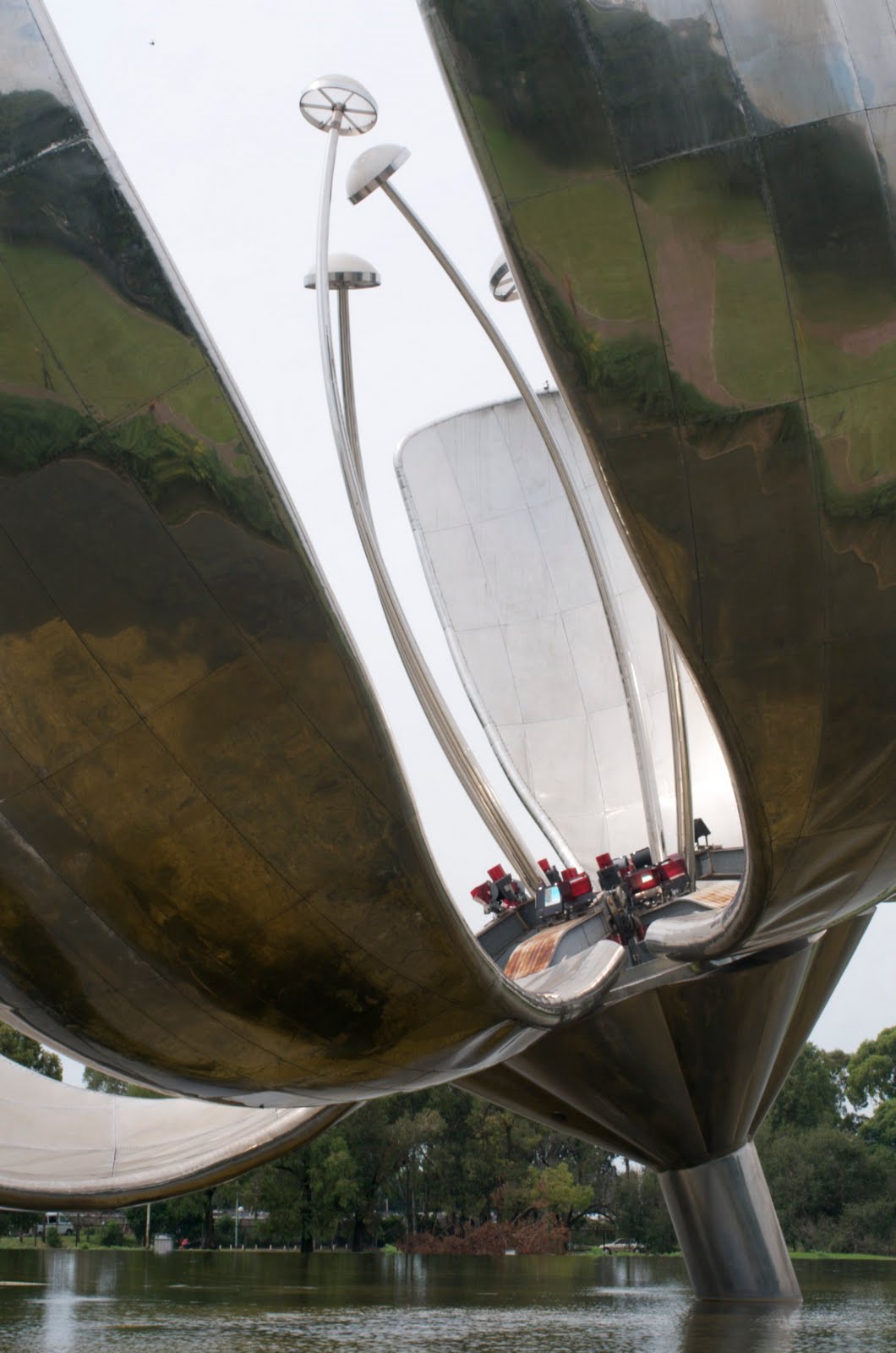
Other parts of town, most notably Palermo, where I have been living, feel a lot more European. At its best, the city can be very stylish - a bookstore in an old theatre, a giant flower sculpture with petals that open and close with the light. Colourful, wild buses that never quite go where you expect them to. The streets buzz with activity, not to mention traffic. At its worst it can be filthy, stinking and claustrophobic.


El Ateneo

Floralis Genérica

Colectivo


In amongst all the mayhem, dog turds and contradictions, are a few little sanctuaries. They mostly take the form of cafes, where one can while away the hours sipping occasionally bearable coffee and watching the world go by. It's hard to imagine the place without them, and you kind of know the other people are in there for the same reason; to take refuge.


Towards the end of the 15-hour flight from London, the Captain announced that we would shortly be arriving in "Beautiful Buenos Aires." At times, I can see his point, at others, less so. Part of the city's appeal is this paradox - you need to constantly shift your perspective in order to see it as a whole. If you stay still, it will grow old on you quickly and lose its charm. Keep moving then - for me that means leaving of course. Tomorrow. Like all good things in life that we take for granted, I know I'm going to miss it once it's gone.

Sunday, 2 May 2010

Yerba Mate

I can't leave Argentina without saying something about mate (ma-tay). Mate is to the Argentineans (and the Uruguayans, Paraguayans, Chileans, plus a few Bolivians and Brazilians who live near their borders) what tea once was to the English. The articulation of a nation's civility, in the form of leaves and water.

You need three things. Firstly, Yerba (the plant) dried and packaged. There are hundreds of varieties that range in bitterness (the drink is basically very bitter, though you can add sugar if you wish). The stalks of the plant are usually included in the mix, that looks not entirely dissimilar to good old 'normal' weed we used to smoke when I was young and stupid.


Yerba mate

The dried leaves and stalks 

Next you need a gourd or mate in which to prepare the brew, and a bombilla, a kind of metal straw through which to drink it. You almost fill it to the top with yerba, and bang it on your hand to remove any excess dust. In goes the first serving of hot (not boiling or boiled) water, and you're ready to drink your first mate.

Mate, yerba and bombilla: the holy trinity

Drinking it feels a bit like smoking a pipe. I can't help but feel a little Holmesian as I pace up an down my apartment puzzling over the latest mysteries to which I turn my keen mind.


A three pipe problem

When the first mate is drunk, you just top up again, and keep going until it loses its flavour. Drink it at home or out and about, with gourd and flask of hot water tucked under one arm. The dexterity of Uruguayans in this respect is amazing, they carry their flask and mate no matter what else they are doing (riding motorbikes, horses, climbing ladders). Drink it alone, or better still, among friends, filling the gourd for each drink and passing it around like a peace pipe. If only we'd had yerba instead of spliffs when I was younger. I'd have made a great detective.

Wednesday, 28 April 2010

Busy doing nothing

My little trip to Uruguay was great fun. I love it there. Reading some other travel blogs, I stumbled across a couple who had taken a similar route to me, and they were shit canning the place because "there wasn't anything to do." Why do people travel? In search of things to do, or something more? I didn't "do" a great deal in Uruguay. I went to one museum. I walked a lot, took a lot of pictures. Drank coffee, ate, a lot. Slept. Want stuff to do? - go somewhere else. I hear Disneyland Paris is nice this time of year. You like museums? Galleries? Theatre? Pubs, bars? Save yourself the airfare - Britain is full of them.

Uruguay's not. It's full of quiet little towns, that are full of quiet, dignified people going about their daily lives. There are no outstanding natural features, historic monuments or ruins. If you need any of those things, or other distractions, then it's probably not for you.

Since my trip was a training exercise in travelling, what did I learn? I learnt that ATM cards, when they don't work, are totally worthless compared to good old fashioned US Dollars. I learnt that cockroaches are a non-lethal hazard to be expected in the coming months. I learnt that bus travel isn't actually that bad, but that they crank the aircon up so you need hundreds of layers despite the fact that it is blisteringly hot outside. I learnt that I actually quite like moving about. What others might be bold enough to call travelling.

The journey back last Friday was a long one with a lot of legs. The most interesting of them was the catamaran across the Tigre delta. Most interesting of that, other than the screaming little brats that filled the top deck, was the approach to Tigre, where the waters are dotted with boats in various stages of decay, disrepair and submersion.


It's pretty funny watching the toffs of Buenos Aires dodging these old shipwrecks in their speed boats. In fact it neatly sums up a lot of the contrasts and contradictions of the city. Other places, they might try and clear the old stuff out of the way. Not here - they work around it. They let nature take its course. The city, the landscape or - in this case - the river, will eventually assimilate the things that are dying in its midst. Meanwhile life goes on around. Me - I'm heading home, to spend one more week "doing" nothing, before home moves on once more.

Thursday, 22 April 2010

Fray Bentos: Ghost town

After the cockroach infested, damp shithole I stayed in the other night, and in a shameful betrayal of the 'traveller' in me, I checked myself into the Gran Hotel Fray Bentos. The 'Gran' is probably stretching it, but at least the 'Hotel' bit won't bring the trade description guys knocking.

This morning I headed for the Museo de la Revolución Industrial early doors. Barrio Anglo, where the meat packing plant once thrived, is a fair walk from the main town. It's a beautiful stroll along the riverfront here, and it takes me ages since I can't stop taking photos. I think it's the wavy lines.


Fray Bentos feels different to the last couple of towns I've been to in Uruguay. Whereas they were bustling, lively and busy, here I just can't seem to find that many people. Even the Rambla was very quiet, though the few people I did see all offered a cheery hello. I thought maybe it was a holiday or something. I wandered further through the town, dotted with leafy parks and open spaces, which doesn't help the sense of emptiness.


No-one here....

.... or here....

.... or here....

.... or here

Looking for a restaurant is a tricky business. The places I found on the internet have either shut up shop or gone for good. Last night I went out for dinner around ten - prime time. There were a few punters in Treinta y Tres, the little joint I finally found, but the streets themselves were deserted (save for a couple of ferocious perros that hounded me for a block or two). I scouted a couple of places this afternoon, but again, when I got there they were shut. Two of the three open places were empty. Despite all this, I really like it here. It's a beautiful town; leafy, spacious and clean. The people, if and when you see them, are remarkably warm and friendly.

I decided to write two entries on Fray Bentos; one on the meat packing and its history, the other on the town, but I'm not convinced that the two are that easily separable. Thirty years ago, Fray Bentos suffered a massive shock - the business that had sustained the local economy for 117 years, ceased production. You can't help but get the feeling that it has never quite recovered. The preservation of the site as a museum only adds to the sense that this is in some ways a ghost town.

This situation is exacerbated by an unprecedented dispute with neighbouring Argentina. Puente General San Martin, the bridge that connects the two countries just outside Fray Bentos, and the only river crossing for 200km, is closed, and has been on and off for the last five years. It is blockaded by residents of Gualeguaychú, Argentina, in protest against allegedly pollutant paper mills being built on the Uruguayan riverbank. It is a staggering situation between two normally amicable governments.

The effect on Fray Bentos is clear - without the passing trade, tourism and freight, the place is in danger of drying up. In a cruel irony, the grand old Río Uruguay that 150 years ago transformed a sleepy little village into a thriving commercial town, is the very thing now isolating it as it tries to rebuild. If agreement isn't reached soon, judging by the state of the place, it's in danger of being suffocated for good.


Sunset over the Río Uruguay


Fray Bentos: a canned history

Combine the words Fray and Bentos and you tend to think of tinned meat pies. Ever wondered where the name came from? Spanish for reclaimed meat? Nope. They took it from the town that kept Europe in corned beef and oxo cubes for more than a century and fed the Allies long enough for them to defeat the Nazis in World War II.


Mmmmm....de-li-cious

In the middle of the 19th century, a crazy German invented a method for compressing 2lb of beef into 1oz of extract. With British financing he opened a processing plant on the Rio Uruguay utilising all the spare meat that was lying about. With it came the Industrial Revolution. All the latest innovations from Europe arrived, and Fray Bentos had electricity three years before anywhere else in Uruguay.


I'm guessing the rust is new

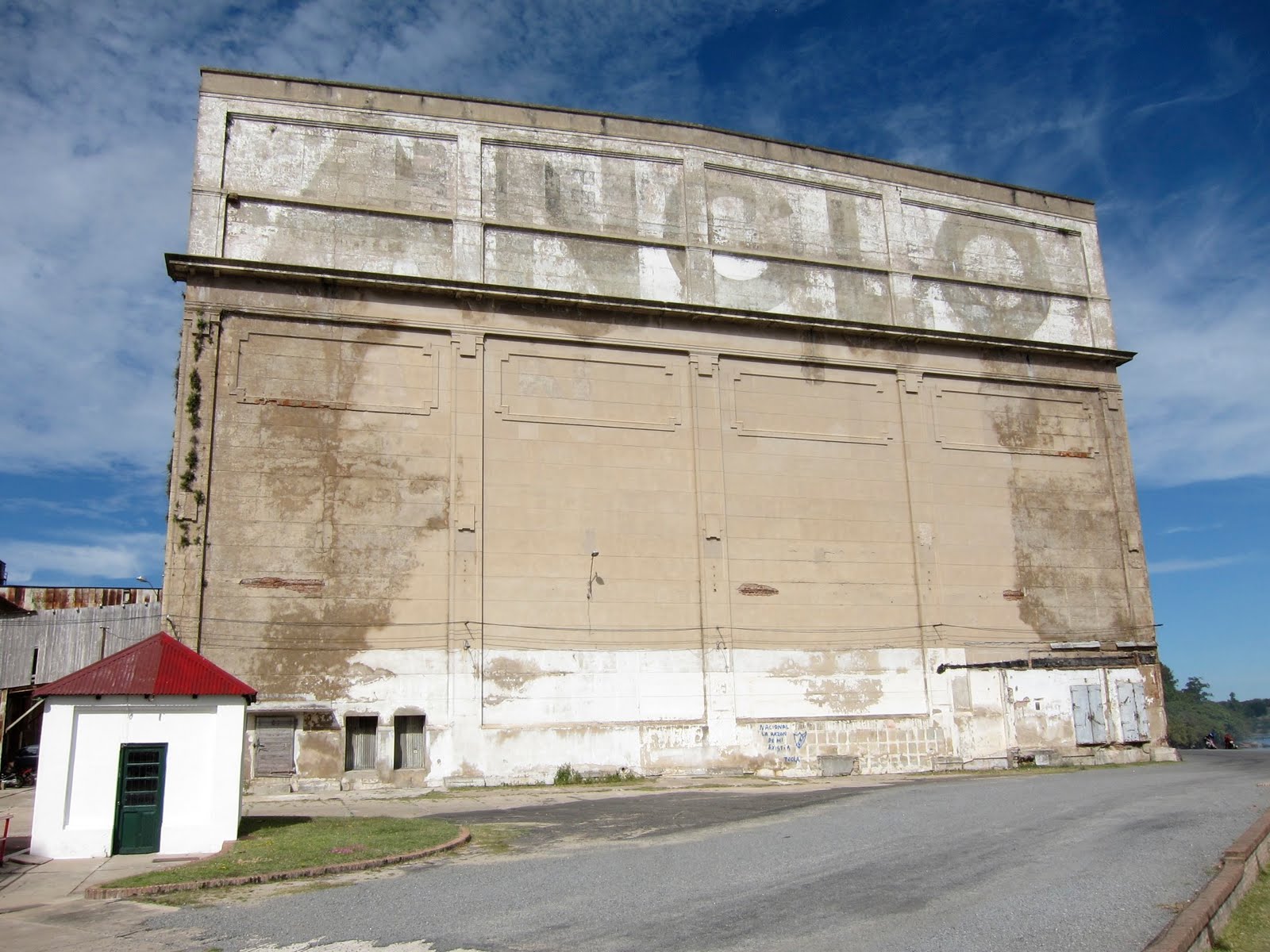
They soon expanded (or is that compressed) into corned beef under the Fray Bentos name, and lower grade extract that was later trademarked oxo, along with 200 sub-products. After the Great War, the German sold out to British interest and the company was renamed El Anglo. The flow of cheap, quality meat was especially important during the war, and Fray Bentos effectively became the kitchen of free Europe. It had the largest meat packing plant and refrigeration unit that has ever existed. Today it is a museum, which is how I came to know all this crap. Amongst the interesting industrial artefacts, the highlight for me was a two headed calf preserved in formaldehyde. Presumably the rest of it ended up as oxo cubes.


And you thought corned beef was good for you

A mural usefully depicts how it all worked

A small town evolved around the plant, now known as the Barrio Anglo. It had its own hospital, even its own crematorium (for those who got too close to the machinery?) Walking around the giant building, you can only imagine what it was like in its heyday. Huge deep keeled ships rolling up the Uruguay to the enormous warehouse. The town within a town, bustling with workers and their families from all over the world. And the smell - one can only wonder. There's not much left of all that now, just a few ramshackle buildings and the old wharf in tatters. But the frigorifico is still standing, and at least they're trying to keep their history alive.


Once the world's largest refrigerator

Hard to imagine it a hundred years ago

Wednesday, 21 April 2010

Mercedes

Western Uruguay really does look like England. In between the towns that is. After two hours of green fields, tractors and acres of rapeseed, I have a couple of hours to kill in between buses in Mercedes.

There's not a great deal going on here, though it's charming enough. I was toying with the idea of spending the night, but thought better of it. After an hour or two, I think it was probably a good call. The town rises away from the bus station, reaches a crescendo around the Plaza Independencia, then falls away again to the river, and the widest costanera in the whole of Christendom.

I stash my bags at the station and walk the ten blocks or so into town. It is still bloody hot, and the clear blue sky persists. The town itself is awash with colours. It's begging for photos. A perfect opportunity to put my new compact to the test.


Missed the name of this church on the walk through town

Disused building on the riverbank

Amazing colours looking upstream along the Rio Negro

The little camera is turning out some awesome shots. Maybe I can survive with a compact after all and leave the SLR at home. I decide to put it's sun shooting skills to the test:


It looks like I'll be lugging the D300 around the world with me for a little while longer. Still, not a bad effort for a baby. I wander back towards the bus station and capture some of the colours, murals and graffiti. 


It has occurred to me that everyone in Uruguay seems so nice, I wonder if there are any assholes here at all. A few blocks later, a graffiti artist responds in the affirmative by eloquently scrawling all over a peace mural. Oh well, nowhere's perfect I guess.