Sunday, 9 January 2011

Ashes to Ashes

Quite frankly, it's piss poor. This is supposed to be a travelogue, blog, log, whatever, and yet I have only posted two things in the last month; one saying I need a holiday, and the other that I have decided to do fu*k all for the next however long. As far as retaining what lingering reader interest may have survived the last year's laborious nonsense goes, this must surely be the death knell.

Or is it? Maybe I wasn't sleeping, but waiting. Poised menacingly like a tightly coiled and pissed off cobra, waiting to explode in a fury of travelling, eating, cooking, photographing and writing brilliance the like of which the world had never seen. But no. I've just been watching cricket.

Many years ago I was an angry ant of a teenage England football supporter. Spilling beer, shouting and chanting mildly offensive drivel. Around that time I worked with an absolute gent (who was probably only 25 himself) called Danno, who once confided in me that he would rather see England win the Ashes (Cricket - England v Australia) than the World Cup (Football, Soccer). I smiled politely and secretly worried about him.

It might have been the eight years as a bookie, when my patriotism yielded to fiscal pragmatism, but I ended up wanting England to lose things, football especially. When I stopped being a bookie, I assumed my patriotism would return, but it didn't. And it didn't because in order to be patriotic, you need to feel pride, and eleven cashed up bogans strutting around a football pitch failing to replicate the form they show for their paymasters whilst carrying on the pretence of representing their country provokes anger and resentment, not pride.

Cricket is different though. Test cricket is the quintessence of a sporting contest; endurance, technique, consistency, teamwork, planning and execution. The Ashes, to an Englishman or Australian, are the pinnacle of that most refined of sports. And the Boxing Day test match at the Melbourne Cricket Ground (MCG) is the highlight of that.


Two Englishmen, a Frenchman and an Australian....


If you are interested in cricket, you know what happened, if you're not I won't bore you; suffice it to say that we utterly destroyed them. It was very special indeed. So special that, after two days at the MCG I decided to shelve a few plans and spend the first week of 2011 in Sydney watching the final match of the series.


Day 4 at the Sydney Cricket Ground

Five consecutive days of test cricket is an epic thing to watch. Even more so thanks to the demolition of Australian cricket engineered on the field, a rotation of great company in the stands, and the effervescent humour of England's travelling supporters, the Barmy Army.


Nic and I looking smug on the final day at the SCG

By the final day there were no Aussies left, just a large, vocal contingent of English people there to watch the denouement; the final decapitation of the old foe coming just a few minutes before lunch. Amidst the celebrations though, came a slight shuddering twinge. England's victory arrived courtesy of the brilliant execution of a masterful plan; Australia's demise the result of hubris. Greatness never resides long in the same place; those which were great once are small today, and those which were small have become great.

Saturday, 1 January 2011

Happy New Year

Right, I'm back. Well, sort of. I was always going to go quiet when I hit Australia. If I've only learnt one thing, it's that I can't write when I stay in the same place and am surrounded by friends. Solitude and flux are prerequisites for my scribbling.

New Year's Eve lends itself to decision making. I've written before about standing on the cusp of things; borders, countries, continents. Decisions. Journeys. When the anticipation of something new mingles with reminiscence over things past, the mind can achieve moments of remarkable clarity.

Here's what I wrote a year or so ago in my first post on this blog:

I don't generally like New Year's Eves, but they do afford one the obvious opportunity, obligation perhaps, to reflect upon the previous twelve months. They also sharpen your focus upon the last one, and force you to join the dots. A year ago I had that moment standing on a balcony of a beautiful holiday home in Fairhaven, down the Great Ocean Road in Victoria, Australia. I gave myself a year to sort things out.

This year, feeling bloated and suffering from a massive sugar crash, I strolled outside for a breath of fresh air. Leaning on the gate and staring out into a beautiful, cold night's sky, I decided I was probably only halfway to being where I want to be. If it took me a year to get halfway, I'd better have one more to take care of the rest. So that's what I did. I deferred the great decision for twelve months, and resolved to hit the road.


This time round it was different. It's been a long year, and I've managed to fit a lot in. How much of it will stand the test of time? What have I really learnt or discovered? How many pillars will remain standing when the tides of time have washed all the other memories away?

The first thing I realised was that there is no halfway. There will never be a New Year's Eve when you can sit and tell yourself that you are there; nothing left to achieve. So it's not a question of apportioning time, or the years, to some great quest or journey of discovery. That journey is your life, and you'll know when you're finished, because you'll be dead. Between now and then, it's simply a question of how you're going to get there.

So I didn't make any grand decisions this time, rather succumbed willingly to the reality that this is life. But at the same time I gave thanks for all the incredible things I have seen and experienced this year. I thought about what I had learned, about the world, about how old, beautiful and incredible it really is, and how I would carry that knowledge with me into the next year, and use it to guide me. And I guess, if I'm honest, that made me think that I would probably not stop travelling just yet.

But being on the other side of the world from your home is tough. I'm lucky enough to be made welcome into other people's homes and families in Australia. But the warmth and love that they extend reminds me of what sits waiting when I get home, and what doesn't too. So maybe next time it won't be a whole year.

A ball started rolling in 2010, and I don't think I'll ever want, or be able, to stop it.

Monday, 13 December 2010

Joe Cocozza is on holiday

No doubt this will sound ridiculous, and is borderline inflammatory to those of you as deep in snow as you are in work, but I need a holiday.

Galavanting around the world is exhausting. Physically, because you sleep in different places, are constantly moving, and busying yourself, because with so few days in each place you feel obliged to squeeze every last drop out of them. Mentally, because you are always thinking and planning - where to go next, how to get there, where to sleep, what to do. And emotionally, because you are miles away from home, alone, fatigued by those other considerations, and wondering how and why you can transcribe what happens every day into some form of meaningful narrative. And that's before you even begin to think about the future; about what happens when a certain plane lands at Heathrow airport one chilly Saturday morning in February.

It's okay, I'm not after sympathy, and I certainly wouldn't deserve or expect it. Not because I am extremely privileged to be in a position to enjoy these experiences at such negligible cost, but because I am in fact already on holiday. I flew up to Brisbane on Thursday, and spent my birthday with two extremely dear friends, Colin and Margot, and their seven month old daughter, Frankie, who is ridiculously beautiful, smiley and friendly.

On Friday we drove up to Sunshine Beach, Noosa, and for the last few days we've been eating great food and swimming in the sea, joined by more friends, for more good times. It rained all day today, but that didn't stop us - Colin, Lofty and I swimming in the sea anyway, the only ones out there, then standing in the street as it lashed down, playing spoof in our swimmers to work out who would go and get the key for the hot tub.

Right now I'm sat on the balcony sipping a nicely mixed Tanqueray and tonic, listening to the roar of the Pacific Ocean barely metres away. I've been circumnavigating it one way or another for most of the last ten months, never really that far away, and to hear those big waves rolling in when I wake takes me back to all those days and nights I hugged its shores. Holidays are great, but travelling will always be greater.

Thursday, 9 December 2010

Hong Kong Revisited

There have been plenty of times in the past year when I've outrun the blog. When the time, will or ability to write were lacking. Take this week for example - last Friday morning I left Phnom Penh and arrived, via Bangkok, back in Hong Kong.

Hong Kong doesn't really count as travelling any more. I've been there more times than any other place outside England, and reintroduced myself on this occasion in the same fashion as all the previous ones; hitting the ground running and getting phenomenally shitfaced. I somehow managed to string a 4am and a 5am finish together, in defiance of my advancing years, and at 11am on Sunday morning was reluctantly boarding a junk from Central pier as my body fought the onset of a brutal hangover. Half an hour later I had turned pale green as the waves shook my insides. Only by finally jumping into an icy sea did I trick myself into a brief recovery, soon side swiped by a premature Tsing Tao and the inevitable remorse.

In between all of this nonsense, I managed to eat a few fantastic meals, catch up with some old friends, meet some new ones and have a generally great time. I've always wrestled with my feelings for Hong Kong, or rather they've wrestled with each other. I love it, hate it, fear it and am in awe of it. Last time I was here, I realised I loved it. I loved it but could never live in it. This time, I'm thinking maybe I'd fancy that challenge one day.

By Tuesday morning I'd shaken off the various hangovers and headed back to the world's greatest cookery teacher, Martha Sherpa, for another day of Chinese food. By the time we'd knocked up spare ribs, poached chicken, beef chow mein, fish in chilli garlic sauce and stir fry pork chop, it was time for me to board the Airport Express once more.

I was hot and tired from the kitchen, but a shower and champagne with a beer chaser straightened me out just in time for the Final Call. For the fourth time since I left last February, and the last before I board the plane home the one coming, a change of continent; at the end of nine long hours, Australia awaits.

Friday, 3 December 2010

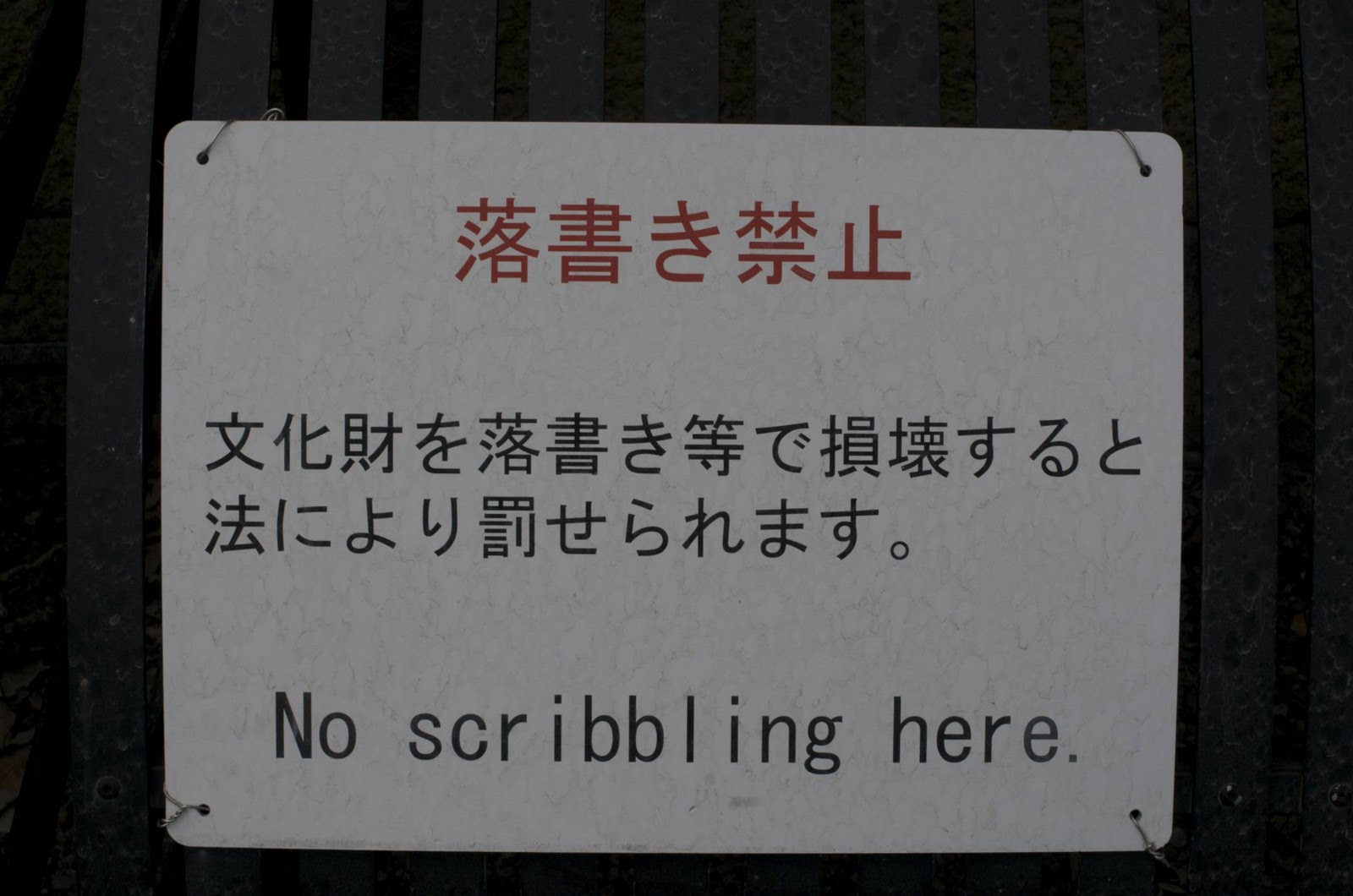
Take off yours hoes please

A selection of my favourite signs from Asia:


Korea

Japan

Japan

Cambodia

Japan

Thailand

Phnom Penh

Phnom Penh used to be known as The Pearl of Asia, which makes it sound more like a dodgy Chinese restaurant than a capital city. But it seems deserving enough of some kind of romantic moniker, rebounding from a turbulent recent past with considerable optimism to embrace the 21st century.

It's a nice city to walk around. I'm staying down by the riverside (with all the other tourists) which is pleasant enough. Flags flutter in the stiff breeze, and when the temperature finally drops, kids play football on the promenade and couples (boy/girl, boy/boy, boy/ladyboy) walk hand in hand or sit and stare out over the river.


Phnom Penh commerce

Phnom Penh transport

Like other cities in Asia, there's a real buzz and energy coming off the streets, and not just from the rotting market detritus or occasional badly ventilated sewer. It's busy, but not Hanoi busy. The people are friendly, but not Laos friendly. But that energy that makes cities interesting and exciting, is usually the result of contrast and clashes. Rich meets poor, east meets west. And the result of that meeting is not always pleasant.

There is a huge, yawning gap between rich and poor. The hotels, bars and restaurants are incredibly expensive compared to elsewhere in the region, but still busy. The money is flowing in then; plenty of 4x4s on the roads, designer boutiques and flash French restaurants testify to that. But among them are the symptoms of an extreme poverty. The market next to my hotel is a thriving hub of commerce by day, and a home to street families by night.


Street market by day, home by night

In Siem Reap, the landmine victims were either booksellers, hobbling about flogging glued together photocopies of guidebooks, or in bands playing traditional music. In Phnom Penh they just beg, and any success they might encounter only serves to encourage others; children, mothers with babies.

I've sounded off about the sex-industry in Asia before, but when you turn onto a street and the bars are called things like The Pussycat and Beers and Babes, where fat, old white guys hang out with young Cambodian girls, the stench of it invades your nostrils. It is one route out of poverty, for sure, but one created by economic exploitation levering a chasm of moral and ethical ambiguity amongst impoverished locals. And no-one seems to bat an eyelid.

I still like the place, in spite of all this. It has soul. But I've been speaking to my brother, who was here eight years ago, and it sounds as if that soul might be diminishing in the scramble for dollars. Maybe that's the way all developing cities go if they're left to their own devices.

Thursday, 2 December 2010

Genocide

Tuol Svay Prey was a High School in Phnom Penh until April 17th 1975, when it became a prison, designated S-21 by the Khmer Rouge.

Classrooms were divided into cells one and a half metres square, to hold the enemies of the revolution; peasants, workers, technicians, engineers, doctors, teachers, students, monks, ministers, soldiers, foreigners, people who wore spectacles. The purpose of their incarceration was to extract confessions by means of torture in order to justify their subsequent execution.


Of the 20,000 people who passed through Tuol Sleng, only seven survived. Each prisoner was photographed, but there are no names to match them, just faces. Human lives reduced to a single moment in time, and it's as though the camera captured just one emotion on each face; confusion, fear, anger, surprise, terror, defiance. Others are just shell shocked, some are even smiling. As a whole, the banks of faces become a palette of human emotions, staring out from beyond the grave.


They weren't executed in Tuol Sleng, but were driven to a Killing Field at Choeung Ek, 15km away, where they were beaten to death with bamboo sticks, hoes and shovels, in order to save bullets. A loudspeaker hung from a tree playing party music to drown out the screams as the pummelled bodies were thrown into mass graves. Babies were smashed against trees in front of their mothers before they were raped and bludgeoned. There were 343 Killing Fields like this is Cambodia, with over 19,000 mass graves, and between them they accounted for somewhere between 1.5 and 2.5 million deaths. No-one knows.

Just under 9,000 bodies have been excavated at Choeung Ek, and their skulls are displayed in a shrine, seventeen storeys high. After heavy rain, more bones and remnants of clothes work their way to the surface, and are collected and preserved. Many of the graves burst open, a result of the gases built up within the corpses they were designed to conceal.


Pol Pot survived for twenty years after these atrocities were committed, dying under house arrest. The first trial of a Khmer Rouge official began in 2009, resulting in a 35-year prison sentence for Comrade Duch, despite his admission to the torture and murder of thousands of Tuol Sleng inmates. Four more await trial, but the hundreds, or thousands, of Khmer Rouge footsoldiers responsible for carrying out their orders, guilty of murder, torture and rape, are living normal lives in Cambodian society today.