Monday, 4 October 2010

In the Zone

There's no official border between North and South Korea, just the Military Demarcation Line from the armistice of 1953. Two kilometres either side of it is the DMZ: the Demilitarized Zone. The Cold War might have thawed out everywhere else, but the Korean divide is still the most militarised frontier in the world, and as frosty now as it ever was.


Just outside the DMZ, you can descend 350 metres into the ground and walk (well stoop) along a damp, narrow tunnel, discovered, in 1978. A North Korean incursion tunnel, it is one of four that have been found, and there are believed to be around ten more. The North Koreans rubbed coal dust along its walls and claimed it was a coal mine, despite the fact there is no coal anywhere near it.

Above ground a sculpture depicts a world being put back together, a map of the Korean peninsula in its centre. Visitors sit through a short film which punctuates the history of the region with gushing talk of reunification and reconciliation.


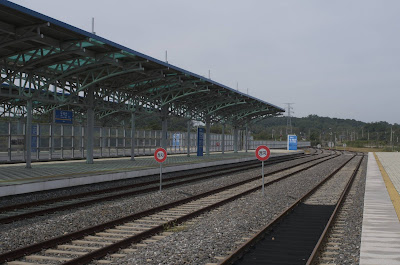
A few miles away is Dorasan Station, rebuilt in recent years. Walking around the plush, modern but deserted terminal, you can't help but think how ridiculous the whole thing is. There are even fake train times flashing on a board and a platform sign showing trains to Pyongnang. It may be a powerful symbol of hope for the South, but it seems little more than naive sentimentality when the other guys are torpedoing your warships and digging secret tunnels big enough to drive armies through. (North Korea has a population of 25 million, but one of the five biggest armies in the world).


Cast the politics aside and what remains is a human tragedy. Barbed wire fences are strewn with coloured ribbons; some in memory of those who died in the war, others for family members stranded on the other side when the country was split in two.


An old train riddled with bullets, a relic of the War, is preserved nearby. It's a sad memento of a conflict that never actually ended; the two sides are still technically at war and hostilities persist. The sinking of a South Korean Navy vessel in March was only one incident in a long history of skirmishes that make reunification seem little more than a dream for now.


It's hard to envisage drastic change any time soon. The North remains under the control of the world's barmiest regime; a brilliantly scripted comedy, were it not so tragically real (the Party conference this week was the first for thirty years). Until that changes, the people of North Korea will continue to suffer and the children of the South won't get any closer to their countrymen than a school trip to the Dora Observatory.


Save for a few outposts and some furtive tunnelling, a thousand square kilometres of the Korean peninsula has remained largely unmolested for the last fifty seven years and a unique natural environment has flourished in the human vacuum. As the dream of reunification persists, along with the imbecilities, the flora and fauna have had a field day in the man made chasm that divides a nation.

Friday, 1 October 2010

Onggi

You see onggi everywhere in Korea. Giant ones, big enough to smuggle a sumo wrestler in, stacked up in people's yards, covered in dust and cobwebs. Tiny ones in shop windows, tabletop ones in restaurants. Fermentation is the quintessence of Korean cuisine and these ceramic jars are the vessels in which it works its magic.


In the tiny village of An-nae, Choi Kil-Dong has an onggi factory. He comes out to meet us with a cheery smile and shows us around. There are maybe six people working for him; mixing and cutting clay, filling moulds, finishing, stacking and wheeling rickety old carts about the place. They all share the same look; a little wizened, but ageless and graceful. They do everything slowly, economically, and by hand.


Hand finishing onggi

Korean society holds artisans in relatively low esteem. There is no recognition for traditional skills like these, handed down through generations and so central to their culture. These guys hide away in their corners, diligently crafting the most wonderful creations. They are artists, and we tell them so. But it won't help. Demand is waning and one day, in ten years maybe, Dong thinks he might not have a business any more.


Lids, drying in the sun

Onggi, dried and ready to be fired

The clay is a mixture of red earth from the nearby hills, charcoal and water; nothing more. The jars it creates, though impermeable, have a unique breathability perfect for fermentation. They also inhibit dangerous bacteria, and have been proven to actually purify water left in them. Mr Dong, a devout Catholic with a holographic Jesus/Mary on the wall of his lounge, believes they are a miracle.

They are round, like ying and yang. The world is round. The sun is round, the moon is round. We are round. Everything man makes is square - fridge, TV, book. One day, maybe I will make square onggi, just to see if they still work

He wears the smile of a man who knows they won't.

Thursday, 30 September 2010

Intercontinental Breakfast

6.30am, the Ibis Gangnam, Seoul: showered, shaved and suited, Korean businessmen arrive for breakfast.

Shortly after dawn in business hotels the world over, the same tragedy is performed. Actors emerge from the intermission and file unthinkingly down to the theatre. They gather their props, the interchangeable components of the continental breakfast, and take position upon the stage. The script takes no remembering; it has no words.

I am an outsider, and not because of my race. (A couple of gaijin join in the ritual cremation of bread and picking up of croissants with tongs). No, I am an interloper; I've wandered through the wrong stage door. I sit quietly in a corner with my bran flakes, toast, sweetened orange juice and appalling coffee, hoping I'm not spotted.

The worlds we inhabit are so close to one another, they're capable of these brief, awkward overlaps. Breakfast over, we withdraw back to our own dressing rooms, continents apart, and the only thing we really share is the insatiated hunger that dogs our mornings.

Okcheon

After a couple of days trying not to look like an American soldier (difficult with my new haircut, since the Korean barber obviously assumed that's what I was and cut my rug accordingly) I met up with a friend from cooking school, Maria from Korea, and we left Seoul for Okcheon.

It's a small town, in the countryside, with few obvious attractions. The local tourist information office, when Maria contacted them, actually asked why we were coming. Wandering around the dusty streets of the oldest part of town, an odd looking local materialises and offers to show us around. I assume he is either the village idiot, the resident drunk or, in such a small town, maybe both, in a combined role.


He is probably slightly drunk, but he is also very kind and pleasant. With Maria translating, he tells me he used to be fluent in English but with no-one to practice on he's forgotten it all. I assure him it's the same with my Korean. He leads us on a stroll around town, pointing out all the old buildings and curiosities.


Things are growing everywhere. Huge pumpkin patches spread over walls, roofs and houses. Rice fields line the roads. Flowers, herbs, cabbage, lettuce, chillies. What isn't growing is drying; every bit of wall is topped with mushrooms, sliced zucchini, more chillies. Apparently main roads are half taken up with drying rice.

We make it back to our guest house and meet the owner. I ask what I should call him, and I think he replies to the effect of Mr Owner of this House. He likes me, and takes us on a tour of all the things he is making. Out the back, in huge ceramic jars, things are fermenting; kim-chee, soy sauce, paste, rice wine. He has jars of sweet rice honey made with malt, reduced and reduced. Bags of leaves and mushrooms are hanging on every eve. Later on we sit down for a homemade meal and everything we eat is a result of the time, care and love he puts into his food.


Mr Owner of this House

Dinner: made by his wife from the ingredients he has prepared

Korean food takes time, because practically everything is fermented. But paradoxically, Koreans are pretty impatient. Even here in the countryside, where people operate fractionally slower than in Seoul, the modern demand for expediency is marginalising culinary tradition.

There's a market in the newer part of town every five days. Fishmongers, live chickens, and even a few dogs (I don't think they're pets) bring noise and colour. Different types of seaweed abound, as do dried insects, biscuits and rice cakes. It doesn't take long to find someone selling knives, and I add a Korean cleaver to my burgeoning collection. They might lack the grace and finesse of the knives I bought in Kyoto, but certainly make up for it in character.


I, or rather we, are something of a curiosity out here in the sticks. Maria is obviously an out of towner and I may as well have two heads. Most people are really friendly, but one stall holder, an old woman, tells Maria to get lost. She says she will bring her bad luck for being with an American. It's sad really; although she is in a minority, her sentiments betray an unbending adherence to tradition that is creating a notable divide between old and young in Korea. It may be that she is a bigoted old fool who is unable to reconcile her Confucian upbringing with the modern world, or it could just be my haircut.

Monday, 27 September 2010

I got Seoul but I'm not a soldier

I must have slept for most of the bus journey from Incheon airport into Seoul. When I finally emerged onto the streets, expecting to have to take a taxi to my hotel, I asked a cab driver if he knew where it was. He looked at me disbelievingly, and pointed over my shoulder. I was standing directly outside it.

A long shower failed to wash away the lethargy from my 5am start. I couldn't face the prospect of travelling into the centre of town, and chose instead to wander around Itaewon where I'm staying. It feels very different to Japan - more westernised for starters. American chains like Taco Bell and Quiznos sit behind market stalls peddling novelty socks and knocked off t-shirts. Bars are either upmarket, opening onto the street, or seedy looking, up discreet staircases that say things like "Western Bar".

There are a lot of foreigners; Indians, Americans, Europeans. Italian restaurants, curry houses, burger joints. It is the most ethnically diverse place I have been in Asia. I keep hearing the sounds of people clearing their throats and spitting. And the further I walk, the more Americans.

I peel up a side street and there's a change of mood. I have never, for a second, felt scared in Asia. Never felt like I'm walking down the wrong street or I need to be on my toes. A Korean guy walks past and looks at me strangely. It's disconcerting, but not really menacing. I can't work it out. I drop back down, and am amazed to find a huge second hand English bookshop; the penny still not dropping as I peruse the shelves.

By the time I find a decent looking place to eat something Korean, I've worked it out. The guy in the restaurant asks me where I'm from - "England", I reply. "Not soldier". He smiles; "You don't look like soldier", he reassures me. Outside the window a big black guy in US army fatigues folds his arms and leans back on his car. The Yongsan Garrison is a grenade's throw away. I devour a bowl of deliciously sweet, rich beef bulgogi and remember why I love Korean food so much.

I've almost certainly been drinking too much lately. I need a night off. Fortunately, the prospect of getting drunk in a "Western Bar" full of squaddies, hookers and the occasional spitting local makes an early night a pretty easy pill to swallow.

Fuji-san

Whatever the little itch that unsettled me on Friday really was, I felt pretty sure a trip out to the Mount Fuji National Park would scratch it into oblivion. Four hours after strolling knowledgeably through the human circus that is Shinjuku station, Dave and I, replenished by udon noodles, were off on our rented bikes (ladies' bikes) around Lake Kawaguchi while the majestic cone of Fuji-san, resplendent in the afternoon sun, watched over us. Glorious doesn't even come close.

Halfway round and we kicked up our stands outside a cafe and sipped coffee in the shade. The wake boarders cavorted on the lake and the clouds rolled in and over the old volcano, never quite lingering long enough to upset his venerability. We breathed in the unbelievably fresh, clear air, and sat in awe.


Sitting there you can't help but think about the innate beauty of the world. There is very little left in me now that can say with any honesty or conviction, that I would rather live within the confines of a city than the countryside.

Which made the trip halfway up Fuji the next morning a little disappointing. The road ends at the fifth station where a grotesque cluster of appalling souvenir shops and third rate restaurants dig their claws into the side of the volcano like a mangy, reticent cat. My respect for the US National Park Service grows silently inside; they would never allow anything this ugly to tarnish such a special place.


Things improve as we drop below the tree line and escape the hordes. The summit is obscured but it doesn't matter; we pick our way along pathways over the volcanic ash as the mist envelops us. The drifting cloud, the cold, the trees; all these things combine to conjure a sense of magic and enchantment. The spirituality is tangible.


Looking at the great cone from a distance, or standing on the slopes, you could be forgiven for being impressed by its permanence. But the mountain yields to the seasons, and changes its appearance in line with their whims; the first snow fell just this week. And you might just forget too that the earth has rumbled underneath this spot for millions of years, and belches forth its fury every few centuries or so, just to remind us that things don't stay the same for ever.

Friday, 24 September 2010

A question of perspective

I seem to suffer these strange lulls when I stay in the same place for more than a few days. It happened in Buenos Aires, again in Texas and it's happening now in Tokyo.

Maybe it's staying in an apartment. Having a set of keys, going shopping, knowing your way home. Whenever I have stayed still for too long, I've got the feeling that I am somehow wasting time. That something, maybe me, is suffering.

Today I experienced a strange kind of nausea, at the train station. When you're travelling, everything new you have to try to make sense of, makes sense to someone. Not knowing where you are going, being unable to communicate, you just take your time and don't mind looking stupid as you attempt to work it out. Emerging from the underground into Shinjuku station is like being blindfolded, spun around in darkness and thrust into the centre of, well, Shinjuku station.

I'm looking for a particular bus terminal. I've got a guide book telling me where it is, and maps and signs everywhere. I think I know where I'm going, but a few twists and turns later and I'm losing my bearings along with my patience. I spend ten minutes trying to reconcile the map on the wall with the one in my hand, before I notice it is oriented east-west as opposed to north-south. I turn my head on its side, and things begin to make sense.

There was no sign of where I was meant to go, though there were signs for just about everything else. I resigned myself to the futility of my situation and, desperate for a new aspect, wandered north, or was it west, to the Tokyo Metropolitan Government Office, which has an observation deck on the 45th floor.


There's nothing like looking down on a city from a great height to put things in perspective, and I quickly begin to see through to the heart of my malaise. From each window I see the same thing: 35 million people in the largest metropolitan area in the world, stretching far beyond the horizon in every direction.

You can't take taxis in Tokyo; they're too expensive. You can't walk; it's too hot. You take the train or the subway. Which means traipsing through vast underground networks of tunnels, staircases and corridors. Fathoming exits and platforms, under the constant watch of endless vending machines and bizarre posters. And everywhere there are people. Millions and millions of them, all being squeezed through the same tiny aperture.


Rejuvenated and refreshed, I take the elevator back to the first floor and find the tourist information. With much smiling, they furnish me with a map, and I realise my guide book was wrong. I walk, happily now, to where I need to be, buy my tickets and ride the subway home, where I fall into a deep, tired sleep. When I wake up the bus tickets are next to me. In the morning they'll carry us out of here, to the countryside. I think not a day too soon.