So many times on this trip have I walked into a restaurant with a tingle of anticipation. Maybe, just maybe, I am about to experience something special. Getting out of the cab I turned to Jon and said I had a good feeling. I instantly regretted doing so. I'd said, or thought it, too many times. I needn't have worried.
Cabaña Las Lilas is a big place. A lot of tables, a lot of waiters. A plate arrives with assorted hors d'oeuvres. Bread too. A little plate between two of assorted savouries to accompany the cup of excellent vegetable soup. I barely noticed these things arrive, the waiters floated around the table without ever really disturbing us. When the hors d'oeuvres were finished, another plate appeared in their place.
We shared an entrada of mollejas (sweetbreads). They were the finest I have eaten in Buenos Aires, and I have eaten a lot. What more can you say? Our mains followed; a rib of beef, kobe ojo de bife (ribeye) and suckling pig. They were all exceptionally good. We needed something more, so topped up with kobe bife de chorizo (sirloin). If you wanted to be especially critical, it might have been a little over salted. But really, even if it was, it couldn't detract from the fact that it was unbelievably juicy, tender and dripping with flavour. Delectable. Maybe that's what happens when you have your own private ranch to supply your meat.
We followed all this up with assorted desserts. A plate of baked fruits was the highlight. I felt I needed something more. A little palette cleanser. Maybe a gin and tonic? A glass of something bubbly perhaps? (Earning a reprimand from Marco for wanting anything acidic). Then I realised what I wanted. Of all the drinks in the world, surely nothing could crown this meal more than a grappa. We ask the waiter if they have any. He explains that they are just about to bring us grappa and limoncello. Every table gets it after their meal. I fight back the tears. This place is heaven.
Food is one thing. Service is another. Throughout the meal, we were looked after impeccably, but without intrusion. At one point, I watched the head waiter walk past our table. He discreetly scanned us as we ate. In how many restaurants would he have stopped and asked us if everything was ok? Nearly all of them. What did he do? He walked right on by. He knew he didn't need to ask.
With coffee came a tray of petit fours. When one of them ran out and we asked for more, another tray, twice the size, arrived in its place. Of course after so many things to please the soul, the coffee couldn't possibly hold up its end of the bargain, and especially not in a town where the standard is so low. But it did. The best coffee I've had in Buenos Aires, to add to the best everything else.
Maybe that's it now - the search is over. I've found a restaurant I truly, truly love, right here. The kind of place that will lift you effortlessly from the deepest depression just by the very thought of dining there. Not that I need lifting anymore.
Saturday, 10 April 2010

Friday, 9 April 2010
Asado
The biggest food tradition in Argentina is the asado. The barbie. The barbecue. The grill. Call it what you like. Meat grilled over hot coals. Restaurants that cook in this style are called parrillas, and they are everywhere. But there is a real difference what they turn out and what people cook in their own homes and gardens.
In pursuit of more intel, I signed up for an asado course in a suburb called Adrogue. The train out there was interesting enough, and I eventually found the place, tucked away in a tree lined street. I couldn't miss it really, there were three gringos waiting outside afraid to go in in case the dog bit them. That should have been the least of their worries - the dog doesn't charge 110 USD for an afternoon's cooking.
We traipse off to the local carniceria to pick up our supplies. The traditional Argentine asado contains a few cuts of beef, maybe some pork, some sausages and some offal. Today we are cooking; matambre de vaca (beef flank), asado de tira (beef short ribs), bife de chorizo (sirloin), matambrito de cerdo (pork flank), chorizo de cerdo (pork sausages), morcillas (blood sausage or black pudding), chinchulines (lower intestines), mollejas (sweetbreads) and kidneys.


First up you need some fire. Argentine asados use the wood of the quebracho tree from the Northwest. It is incredibly dense and sinks in water. You can use other stuff but this is the best. We get it burning early and go inside to make empanadas.

The offal takes a long time to cook so goes on first. Intestines wouldn't be my first choice, but if they crisp up enough and with a bit of lemon juice, I like them. They're nowhere near as strong a taste as kidney. The sweetbreads are the culinary find of the trip so far for me. I love them. Again, I prefer them thinner and crispy on the outside. Today we are cooking the thymus gland, though the thyroid and pancreas come under the sweetbread banner too. They are soaked in water first.


Next up go the sausages, followed by the meat. The beef is only ever seasoned with salt, no marinades are used. We knock up a chimichurri and a salsa creolla to go with the finished products instead. I've seen the matambrito de cerdo cooked with half a lemon on top and that is far superior to without. The meats are served in sequence as and when they are ready by the asador. In this case, Bruno.

I've got all the books (in Spanish) and when I finally arrive back in England, assuming I can find somewhere to live, I'm building myself a proper Argentinian parrilla in the back yard, complete with mud oven for making the coals. When it's finished, maybe summer 2011 or 2012, you can all come round and try for yourselves.
In pursuit of more intel, I signed up for an asado course in a suburb called Adrogue. The train out there was interesting enough, and I eventually found the place, tucked away in a tree lined street. I couldn't miss it really, there were three gringos waiting outside afraid to go in in case the dog bit them. That should have been the least of their worries - the dog doesn't charge 110 USD for an afternoon's cooking.
We traipse off to the local carniceria to pick up our supplies. The traditional Argentine asado contains a few cuts of beef, maybe some pork, some sausages and some offal. Today we are cooking; matambre de vaca (beef flank), asado de tira (beef short ribs), bife de chorizo (sirloin), matambrito de cerdo (pork flank), chorizo de cerdo (pork sausages), morcillas (blood sausage or black pudding), chinchulines (lower intestines), mollejas (sweetbreads) and kidneys.

Chinchulines - lower calf intestines

Matambre de vaca - beef flank
First up you need some fire. Argentine asados use the wood of the quebracho tree from the Northwest. It is incredibly dense and sinks in water. You can use other stuff but this is the best. We get it burning early and go inside to make empanadas.

The offal takes a long time to cook so goes on first. Intestines wouldn't be my first choice, but if they crisp up enough and with a bit of lemon juice, I like them. They're nowhere near as strong a taste as kidney. The sweetbreads are the culinary find of the trip so far for me. I love them. Again, I prefer them thinner and crispy on the outside. Today we are cooking the thymus gland, though the thyroid and pancreas come under the sweetbread banner too. They are soaked in water first.

Left to right: intestines, sausages, black pudding, sweetbreads and kidneys

They look a bit more appetising after a little fire
Next up go the sausages, followed by the meat. The beef is only ever seasoned with salt, no marinades are used. We knock up a chimichurri and a salsa creolla to go with the finished products instead. I've seen the matambrito de cerdo cooked with half a lemon on top and that is far superior to without. The meats are served in sequence as and when they are ready by the asador. In this case, Bruno.

I've got all the books (in Spanish) and when I finally arrive back in England, assuming I can find somewhere to live, I'm building myself a proper Argentinian parrilla in the back yard, complete with mud oven for making the coals. When it's finished, maybe summer 2011 or 2012, you can all come round and try for yourselves.
Tuesday, 6 April 2010
Rosario, Santa Fe
Four hours on a bus, north-west of Buenos Aires, and you find yourself in Rosario. It's like a miniaturised BsAs, and seems like a nice place to spend semana santa. Four hours on a coach is no-ones idea of fun and having declined the 'lunch' they provide we are starving by the time we arrive. A few blocks from the hotel we find La Pergola, a parrilla packed to the rafters on Good Friday, and wash down a couple of milanesas and some barbecued vegetables with a large cerveza, necessitating a lengthy siesta.
There's not a lot of fish on offer in Buenos Aires (even on Good Friday) but Rosario is different. It's on the banks of the Paraná, and as such, there are a range of river fish on every menu. I take on a Surubí off the specials board at a place called Amarra. I don't know what it is, but it comes in a steak, big and meaty with yellow flesh. It certainly tastes rivery. A bit of wiki-research reveals it to be a tiger catfish. Another one to cross off the list then.
.jpg)

Rosario is a nice town to just wander around. Further down the costanera you hit the Monumento Nacional a la Bandera - the national monument to the Argentine flag. It was here, in 1812 that General Manuel Belgrano raised the Argentine flag for the first time. The spot is marked by a massive tower and a few hectares of concrete. It's a central point for the locals to hang out, spilling onto the grassy banks and generally taking it easy.


After all this walking, tengo hambre. I spy the local burger van and put in my order for chori-pan. Forty minutes later (!) my number is up and I take custody of an unfeasibly large hot dog. I'd like to say it was worth the wait, but sadly it wasn't. But it keeps me going for a little longer...

Guessing that the food on the coach won't hold much sway, we tuck into a big lunch of matambrito de cerdo (pork flank) to keep us going throughout. The four hour coach trip takes six on the way back. It would seem that the same illness that grips the M5 every bank holiday affects the RA9 to Buenos Aires. I can't say I'm too fond of this mode of transport but if it helps me skip town to more peaceful climes every once in a while, I can't really complain.
There's not a lot of fish on offer in Buenos Aires (even on Good Friday) but Rosario is different. It's on the banks of the Paraná, and as such, there are a range of river fish on every menu. I take on a Surubí off the specials board at a place called Amarra. I don't know what it is, but it comes in a steak, big and meaty with yellow flesh. It certainly tastes rivery. A bit of wiki-research reveals it to be a tiger catfish. Another one to cross off the list then.
.jpg)
Round and about the Monumento Nacional a la Bandera

Rosario is a nice town to just wander around. Further down the costanera you hit the Monumento Nacional a la Bandera - the national monument to the Argentine flag. It was here, in 1812 that General Manuel Belgrano raised the Argentine flag for the first time. The spot is marked by a massive tower and a few hectares of concrete. It's a central point for the locals to hang out, spilling onto the grassy banks and generally taking it easy.

Taking it easy by the costanera

After all this walking, tengo hambre. I spy the local burger van and put in my order for chori-pan. Forty minutes later (!) my number is up and I take custody of an unfeasibly large hot dog. I'd like to say it was worth the wait, but sadly it wasn't. But it keeps me going for a little longer...

More Pan than Chori
Guessing that the food on the coach won't hold much sway, we tuck into a big lunch of matambrito de cerdo (pork flank) to keep us going throughout. The four hour coach trip takes six on the way back. It would seem that the same illness that grips the M5 every bank holiday affects the RA9 to Buenos Aires. I can't say I'm too fond of this mode of transport but if it helps me skip town to more peaceful climes every once in a while, I can't really complain.
Tuesday, 30 March 2010
Return to Salta
In all the excitement of my few days in the Quebrada de Humahuaca, I kind of forgot about Salta. It wasn't that nice really, probably just the change from Buenos Aires that did it. I got back Saturday night after a long bus journey and headed out for dinner.
I've been keeping a notebook of every restaurant I go to along the way. This is the nicest dining room I've been in. There's a wonderful buzz - a chatter that floats above the tables punctuated only by the clattering of cutlery. A couple of waiters take up a guitar and drum. I don't like live music in restaurants. But I like it here. The whole room is alive and happy. Looking around, everyone is smiling. Isn't that the whole point?
I wake up late on Sunday, since I sank another beer and watched Rocky III in my hotel room. Predictions? Pain. I've got six hours before my flight, so after a big lunch in the plaza, I head up the teleférico - a Swiss made cable car that takes you to the top of Cerro San Bernardo. Like every hill in South America, it comes complete with it's own Jesus, and some wonderful views. It occurs to me that people are walking around with those bunches of leaves because it is Palm Sunday.


After a coffee or two and just chilling for a while, I head back down. I'm kind of fascinated by the cable car itself. How much convincing would it have taken to get in the first ever one? This guy only dates from 1987 apparently, but the technology still looks somewhat primitive. Either way, it works. And it beats the hell out of the steps.


Back at the bottom I stroll through the park and remember completely why I liked this place so much. Everyone is just taking it easy. They're all smiling, eating ice creams, sailing round the boating lake. It is a town completely at peace with itself. Not that there's anything wrong with Buenos Aires, but all big cities, by their nature, suffer from the same complaints. I'd take the composed, effortless, tranquility of Salta before the frenetic mayhem of BsAs any day of the week. And so would they. It's written all over their faces.


I've been keeping a notebook of every restaurant I go to along the way. This is the nicest dining room I've been in. There's a wonderful buzz - a chatter that floats above the tables punctuated only by the clattering of cutlery. A couple of waiters take up a guitar and drum. I don't like live music in restaurants. But I like it here. The whole room is alive and happy. Looking around, everyone is smiling. Isn't that the whole point?
I wake up late on Sunday, since I sank another beer and watched Rocky III in my hotel room. Predictions? Pain. I've got six hours before my flight, so after a big lunch in the plaza, I head up the teleférico - a Swiss made cable car that takes you to the top of Cerro San Bernardo. Like every hill in South America, it comes complete with it's own Jesus, and some wonderful views. It occurs to me that people are walking around with those bunches of leaves because it is Palm Sunday.


After a coffee or two and just chilling for a while, I head back down. I'm kind of fascinated by the cable car itself. How much convincing would it have taken to get in the first ever one? This guy only dates from 1987 apparently, but the technology still looks somewhat primitive. Either way, it works. And it beats the hell out of the steps.


Back at the bottom I stroll through the park and remember completely why I liked this place so much. Everyone is just taking it easy. They're all smiling, eating ice creams, sailing round the boating lake. It is a town completely at peace with itself. Not that there's anything wrong with Buenos Aires, but all big cities, by their nature, suffer from the same complaints. I'd take the composed, effortless, tranquility of Salta before the frenetic mayhem of BsAs any day of the week. And so would they. It's written all over their faces.


Monday, 29 March 2010
Humahuaca
I eventually woke to find Humahuaca bathing in magical early evening light. Everything in the town was glowing, I had to rub my eyes to believe it. I strolled around for a while, fuelled by my third gatorade of the day, snapping away. I couldn't face a proper meal and survived on a few alfajores bought off some dude. First impressions again (not counting the walk from bus to bed) and this is my favourite of the three towns I've stayed in in Jujuy.


Come morning I am feeling normal again. I decide to take a cab to a hillside cemetery we passed in the bus and I'd read about in the guides. I trawl Frommers and the Lonely Planet looking for it's name but the entry seems to have mysteriously vanished. I splutter out my request to the taxistas and head off. After a while, no cemetery. Definitely not where I left it. Then it transpires that the one I'm looking for is Maimara, which is south of Tilcara, not Humahuaca. God I must have been tired. I basically forgot a whole day. 30 pesos later and my cabbie drops me at Humahuaca cemetery instead, which he insists is very nice. And it is.


Their cemeteries here are alive with colour, and they build little houses for the dead people to live in. It's Saturday morning and the place is buzzing with people, tending graves, arranging flowers, and there's even a new guy being interned. I feel awkward strolling about with my camera, an obvious gringo, but everyone smiles and says hello. They really are great. Everyone raves about Recoleta Cemetery in Buenos Aires, but given the choice, I'd definitely rather see out eternity here, away from all the pollution, cats, famous dead people and American tourists.
I walk back into town past the monumento a los héroes de la Independencia. I'm sure they'd be proud of it. It towers over the town, fist clenched and raised triumphantly. Which is pretty much how I feel when I get to the top of all those steps.
.jpg)

It's Saturday. I had thought about taking the tren a las nubes - a crazy train ride that takes you up into the Andes on a winding, spiralling track. It is meant to be amazing. But you're on the train for 17 hours. I sit in the Plaza Santo Gomez, sipping gatorade in the shade, watching the world go by and congratulate myself on not going. A cute little kid picks the right moment to ask me to buy her some food and walks off with ice creams in every pocket. Once I get lunch out of the way, I'll be ready to leave. Sadly.


Come morning I am feeling normal again. I decide to take a cab to a hillside cemetery we passed in the bus and I'd read about in the guides. I trawl Frommers and the Lonely Planet looking for it's name but the entry seems to have mysteriously vanished. I splutter out my request to the taxistas and head off. After a while, no cemetery. Definitely not where I left it. Then it transpires that the one I'm looking for is Maimara, which is south of Tilcara, not Humahuaca. God I must have been tired. I basically forgot a whole day. 30 pesos later and my cabbie drops me at Humahuaca cemetery instead, which he insists is very nice. And it is.


Their cemeteries here are alive with colour, and they build little houses for the dead people to live in. It's Saturday morning and the place is buzzing with people, tending graves, arranging flowers, and there's even a new guy being interned. I feel awkward strolling about with my camera, an obvious gringo, but everyone smiles and says hello. They really are great. Everyone raves about Recoleta Cemetery in Buenos Aires, but given the choice, I'd definitely rather see out eternity here, away from all the pollution, cats, famous dead people and American tourists.
I walk back into town past the monumento a los héroes de la Independencia. I'm sure they'd be proud of it. It towers over the town, fist clenched and raised triumphantly. Which is pretty much how I feel when I get to the top of all those steps.
.jpg)

It's Saturday. I had thought about taking the tren a las nubes - a crazy train ride that takes you up into the Andes on a winding, spiralling track. It is meant to be amazing. But you're on the train for 17 hours. I sit in the Plaza Santo Gomez, sipping gatorade in the shade, watching the world go by and congratulate myself on not going. A cute little kid picks the right moment to ask me to buy her some food and walks off with ice creams in every pocket. Once I get lunch out of the way, I'll be ready to leave. Sadly.
A brief struggle
After the match, fuelled by a few cervezas, we climbed one of the hills to drink some mate and admire the view. I'm admiring these guys' patience as I stutter out my ill-conjugated Spanish.

The sun is slinking down for a well earned rest as we decide to circumnavigate the village via the paseo de los colorados. Night falls about half way round. I am starting to feel properly shattered by this point. The best I can manage is food (llama) and sleep.
The llama and I have a post digestive disagreement and I spend most of the night awake with stomach cramps. When I don't have stomach cramps, my sun burnt shoulders are rubbing against the sheets in agony. Check out time arrives and I am done for. Sun, altitude, cerveza, exercise, lack of sleep and llama have combined to put me in the hurt locker. I skip breakfast, sink a gatorade and board the bus for Tilcara.

I'm headed for Humahuaca but wanted to stop here on the way. I step off the bus into yet another dusty little town, though it's bigger than Purmamarca. I'm in no fit state to do the place justice. I buy myself some food and water to take on the walk up to el Pucará, a pre-Hispanic hilltop fortress that overlooks the town.

The walk is okay but I start to feel a bit of altitude in my weakened state. At the top I settle down for my sandwich but it is inedible. I trudge back to town having admired the view and scull another gatorade. I trudge around town a bit more before making a snap decision to skip town, and bundle my things on a bus that is about to leave.
I must have crashed on the bus, since before I knew it I was in Humahuaca, rucksack cutting into my sunburnt shoulders and no idea where I'm going. I don't care what desperate shithole I stumble into, the first place I find with a bed for me I stay in. There are signs up everywhere for places, but the hostels themselves are nowhere to be seen.
.jpg)
I inexplicably cross a bridge, and find myself ringing the bell of the Hostería Camino del Inca. $220 a night! ¡Gracias a dios! I was thinking I'd have to settle for $10 and they give you a bucket to crap in, but no. I nestle down between the soft sheets and sleep for a thousand years.

The sun is slinking down for a well earned rest as we decide to circumnavigate the village via the paseo de los colorados. Night falls about half way round. I am starting to feel properly shattered by this point. The best I can manage is food (llama) and sleep.
The llama and I have a post digestive disagreement and I spend most of the night awake with stomach cramps. When I don't have stomach cramps, my sun burnt shoulders are rubbing against the sheets in agony. Check out time arrives and I am done for. Sun, altitude, cerveza, exercise, lack of sleep and llama have combined to put me in the hurt locker. I skip breakfast, sink a gatorade and board the bus for Tilcara.

Tilcara
I'm headed for Humahuaca but wanted to stop here on the way. I step off the bus into yet another dusty little town, though it's bigger than Purmamarca. I'm in no fit state to do the place justice. I buy myself some food and water to take on the walk up to el Pucará, a pre-Hispanic hilltop fortress that overlooks the town.

View from el Pucará
The walk is okay but I start to feel a bit of altitude in my weakened state. At the top I settle down for my sandwich but it is inedible. I trudge back to town having admired the view and scull another gatorade. I trudge around town a bit more before making a snap decision to skip town, and bundle my things on a bus that is about to leave.
I must have crashed on the bus, since before I knew it I was in Humahuaca, rucksack cutting into my sunburnt shoulders and no idea where I'm going. I don't care what desperate shithole I stumble into, the first place I find with a bed for me I stay in. There are signs up everywhere for places, but the hostels themselves are nowhere to be seen.
.jpg)
I inexplicably cross a bridge, and find myself ringing the bell of the Hostería Camino del Inca. $220 a night! ¡Gracias a dios! I was thinking I'd have to settle for $10 and they give you a bucket to crap in, but no. I nestle down between the soft sheets and sleep for a thousand years.
Las Salinas Grandes
I sleep all right in the hostel, though foam pillows should definitely be banned. And I'm up early to take a trip out to the salt flats. I'm the only gringo on the minibus that takes fifteen of us out on the hour or so drive.
I'm excited about this - mainly for the photos, but as usual, things don't quite work out as planned. The best thing about the trip is the drive - it is breathtaking (in more ways than one). We start out along a gorge bordered by craggy ridges and peaks, before rising out of the valley, and stopping for photos.

We stop again at a peak of 4170 metres. Some guy passes out and the locals administer some coca leaves. I feel for my breath. I wouldn't want to be doing anything more strenuous than paying 15 pesos for a souvenir at this altitude. We press on, and as we descend, we glimpse the salinas in the distance.
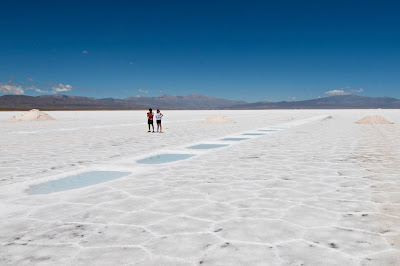
They're very hard to photograph, and I have a kick ass camera. The light is reflecting off the salt and burning the sky. (Not to mention my skin - I now look like am permanently wearing a wifebeater). You can play around with the sense of perspective here, and people come up with some awesome shots, balancing people in their hands, standing on beer bottles, that kind of thing. I don't have a tripod though, and I'm on my own so it's going to be hard. The best I manage is to make myself look like a kind of giant.

The shots of just salt are just boring, and the only ones I really like have some kind of focus.


From the other side of the road on the way back, another chance to glimpse the stunning scenery. The clouds have dropped a little by now and things look very different.

Arriving in Purmamarca around three, I am ferociously knackered. Probably a little bit of sunstroke - I've basically been standing on a mirror at midday on the tropic of capricorn - and a kind of altitude hangover as well. I need rest. But there's a problem. El superclasico is on. My new friends console my bad luck at having missed the game as the residents of this sleepy little hamlet pack the cafes and bars, and we all sink a few beers.
I'm excited about this - mainly for the photos, but as usual, things don't quite work out as planned. The best thing about the trip is the drive - it is breathtaking (in more ways than one). We start out along a gorge bordered by craggy ridges and peaks, before rising out of the valley, and stopping for photos.

We stop again at a peak of 4170 metres. Some guy passes out and the locals administer some coca leaves. I feel for my breath. I wouldn't want to be doing anything more strenuous than paying 15 pesos for a souvenir at this altitude. We press on, and as we descend, we glimpse the salinas in the distance.
They're very hard to photograph, and I have a kick ass camera. The light is reflecting off the salt and burning the sky. (Not to mention my skin - I now look like am permanently wearing a wifebeater). You can play around with the sense of perspective here, and people come up with some awesome shots, balancing people in their hands, standing on beer bottles, that kind of thing. I don't have a tripod though, and I'm on my own so it's going to be hard. The best I manage is to make myself look like a kind of giant.

The shots of just salt are just boring, and the only ones I really like have some kind of focus.


From the other side of the road on the way back, another chance to glimpse the stunning scenery. The clouds have dropped a little by now and things look very different.

Arriving in Purmamarca around three, I am ferociously knackered. Probably a little bit of sunstroke - I've basically been standing on a mirror at midday on the tropic of capricorn - and a kind of altitude hangover as well. I need rest. But there's a problem. El superclasico is on. My new friends console my bad luck at having missed the game as the residents of this sleepy little hamlet pack the cafes and bars, and we all sink a few beers.
Subscribe to:
Posts (Atom)