Wednesday, 4 February 2015

Goa Trance

I must have been seventeen years old, sat on a wooden picnic table, probably smoking a joint, in between A-level classes. A friend approached and, removing a headphone from his ear, generously proffered it to share the contents of the TDK D90 twirling around inside a chunky Sony Walkman. That was the first time I heard Paul Oakenfold's "Full Moon Party" Essential Mix from 1994. The Goa Mix.

It was music that I had never really heard before. And like the music, the word Goa itself conjured up an image of far flung tropical beaches. Beaches thronging with sweaty people from all over Europe, wearing Thai fishermen's pants, matted dreadlocks clinging to their greasy, naked backs, dancing in a crazed, acid fuelled trance, possibly for days and nights on end.

I must say when I rocked up at Anthy's guesthouse on a stretch of golden beach, somewhere between Colva and Benaulim last Friday night, that image felt pretty wide of the mark. I was twenty years older, but if these were the same guys, they were twenty older still, their hair had either gone respectable, or gone for good. Half of them had turned Russian, and if any dancing was being done it was behind closed doors, and after 9pm when they all went to bed.

Colva Beach, Goa
 That isn't to detract from the innate beauty of the beach there, or the incredible hospitality of the people. (A special mention should go to the guy who came to unblock my hut's 'soil pipe'- cheerily crossing the grass and ducking round the back with a shovel slung over his shoulder). I had a nice stopover for a couple of nights and headed further South, to a place called Patnem.

The little street that leads down to Patnem beach isn't suitable for cars, so I'm backpack laden as I pass the tiny shops, and step out onto the baking golden sand for the first time. It takes all of about three seconds for me to fall in love with the place and wonder when, if ever, I could possibly wish to leave.

Patnem High Street, Goa
Patnem Beach, Goa
Patnem is a lot more like the Goa I imagined twenty years ago, but quieter, gentler, calmer. There is a spectrum of people here from all walks of life, of all ages and from all corners of the world. There are a few holidaymakers, a lot of American girls training to be yoga teachers, travellers, people here for months on end just checking out for a while, and old guys who look like they’ve been here for centuries.

It’s hard to express what these people share, but if I had to use one word, it would probably be humanity. I’m sure between them they harbour some pretty crazy ideas about the universe and our place in it, and I’ve heard a few. But mostly there is a harmony and balance to the community here, and it comes from within, from a collective belief in the innate goodness of the world and the creatures that inhabit it. There are friendly faces everywhere; warmth, kindliness and compassion. So many of the things lacking in our everyday lives.

Of course there are downsides to a life here. Beach huts fill the area 100m back from the sand and where they meet, a string of restaurants and bars line the fringe. My hut is one of the last in the line, at the quietest end, but its unique acoustics render it a kind of sound box, and everything sounds louder inside than out. On my first night, people were on the beach fifty yards away, sat around a fire playing their bongos. Later they let off fireworks and whooped and cheered into the early hours of the morning. So much for compassion I thought.

When I finally woke after a restless sleep, the sea had got up in the night. The waves were crashing down outside and I wondered if I needn’t fear for my life. I stepped out onto the ramshackle terrace only to see soft little ripples lapping the sand. I stepped back inside my seashell of a hut to hear them rendered as a tsunami once again.

Maybe the place is rubbing off on me, because each night since I have slept blissfully and uninterrupted. Last night I fell asleep to a horrendous rendition of some U2 song or other at the open mic night next door. Fireworks get incorporated into my dreams, and the gentle rhythm of the bongos, and the sound of people laughing and enjoying themselves rocks me quietly and contentedly off.

Watching the Sun go down on Tuesday evening, I turned to look behind me and noticed that the Moon had already risen. I thought of the moon I watched rising over the Mekong before I entered Laos, four and a half years ago, winched quietly up into the night. Same Moon, same me. I turned west again because it struck me that the three seemed aligned, and so they were – Sun behind, Full Moon in front, and the Earth and I exactly in between.

Monday, 2 February 2015

There is no Greater Love than the Love of Eating

On my first night in India, when I was still unable to leave the cocoon like comfort of the Taj Palace Hotel, I ate the most ludicrously overpriced meal in their house Indian restaurant, Masala Kraft. I mean, it tasted great and everything, but the whole experience felt unauthentic and effortful. It's not what I came here for.

Not wanting to repeat this catastrophe, I enlisted the help of my friend Srila, who basically told me what to eat, where and when, and even treated me to dinner on my last night in Mumbai in what she neatly described as a "Muslim dive". The dive was Sarvi, the Muslims who run it from Iran. They make the most incredible kebabs imaginable. Not a hint of fat or grease, just soft, gently spiced meat, and unleavened breads that they insist on bringing to the table one at a time so you only ever eat them fresh. I'm deeply grateful for being taken here - it is one of those places that you would never, ever stumble across.

On my first day she sent me to Britannia and Company for lunch, a Bombay institution that has been there since 1923 and whose slogan reads: "There is no greater love than the love of eating". Amen to that. They sat me upstairs in the gallery where I looked down on the busy dining hall, packed with people from all corners of the city. 


Berry Pulav, Britannia and Company
I ate their specialty, Berry Pulav, a rice dish served with tiny half dried barberries that explode in little bursts of tangy sweetness as you eat. It's worthy of the reputation and the closeness with which they guard their recipe. Britannia is owned by a Parsi family, who import the berries from Iran. The Zoroastrians fled modern day Iran when the Muslims invaded Persia, back when the centuries were still in single figures. When they eventually settled in India they became known as Parsis.

Later that evening I dined at another Bombay institution, Trishna, a Southern Indian place specialising in seafood. They're famous for their butter and garlic crabs, which are indeed delicious, but the Hyderabadi Fish blows them out of the water (sorry). There are rare moments in life when your first taste of a certain food causes an almost transcendental experience. Your head rises as your shoulders drop. A smile edges across your face and you exhale an involuntary sigh of deep, spiritual pleasure as your soul is uplifted. This was one of them. Garlic, turmeric, black pepper, lots of black pepper, and who knows what else. The best fish I have ever eaten, end of story.

Hyderabadi Fish Tikka, Trishna
For lunch the next day Srila sent me to eat Gujarati street food at Soam, where a kindly waiter took me through the menu. Rice pancakes grilled between banana leaves, the Bombay staple of bhel puri, potato vadas and a paneer paratha with an amazing guava raita. It is all vegetarian, and all delicious.


Bhel Puri, Soam
I felt heavy after lunch, so wandered up the countless steps opposite the restaurant to the Shiva Temple of Babulnath, high up in the Gods. With every yard I climbed I wondered if I wasn't intruding on someone's home, so many people seemed camped out or asleep along the way. At one point, I was standing looking at a shrine surrounded by all kinds of images and icons, so much bright orange, that it was quite some time before I noticed a giant man stretched out among them. Perturbed by his stillness I moved swiftly on, until I reached the strangely quiet summit.

The original temple was built by Gujarati Hindus on land owned by the Parsis, who fought its construction until the 18th century. Zoroastrians believe that the earth and fire are sacred entities, and are unwilling to contaminate them with the bodies of their dead. Instead of cremation or burial then, a Parsi cadaver is disposed of by a process of ritual exposure. The agent for this is a Dakhma, or Tower of Silence, a round building on top of which the shrouded bodies are laid out to rot in the sun until consumed by vultures. A few hundred metres beyond Babulnath stands the last remaining Tower of Silence in Mumbai, still in use today, where the Parsi dead offer up their corpses in a final act of charity, as food for the birds. 

Tower of Silence, Malabar Hill, Mumbai


Saturday, 31 January 2015

The Mandovi Express

I don’t know how many people were on the train today, but let’s assume it was a lot more than any other train I've taken in my life. I’m all for slumming it with the locals (the theory), but an eleven-hour train journey is not the place for that, and in a lucky twist I end up with a first class sleeper cabin all to myself (the practice). RESULT.

However, my first thought when the cheery guard slides the door shut is of the words of my friend Max, who spent five days straight on a train from Beijing to Moscow: “Now I know what prison must feel like.” Trains and prisons: they both have guards....


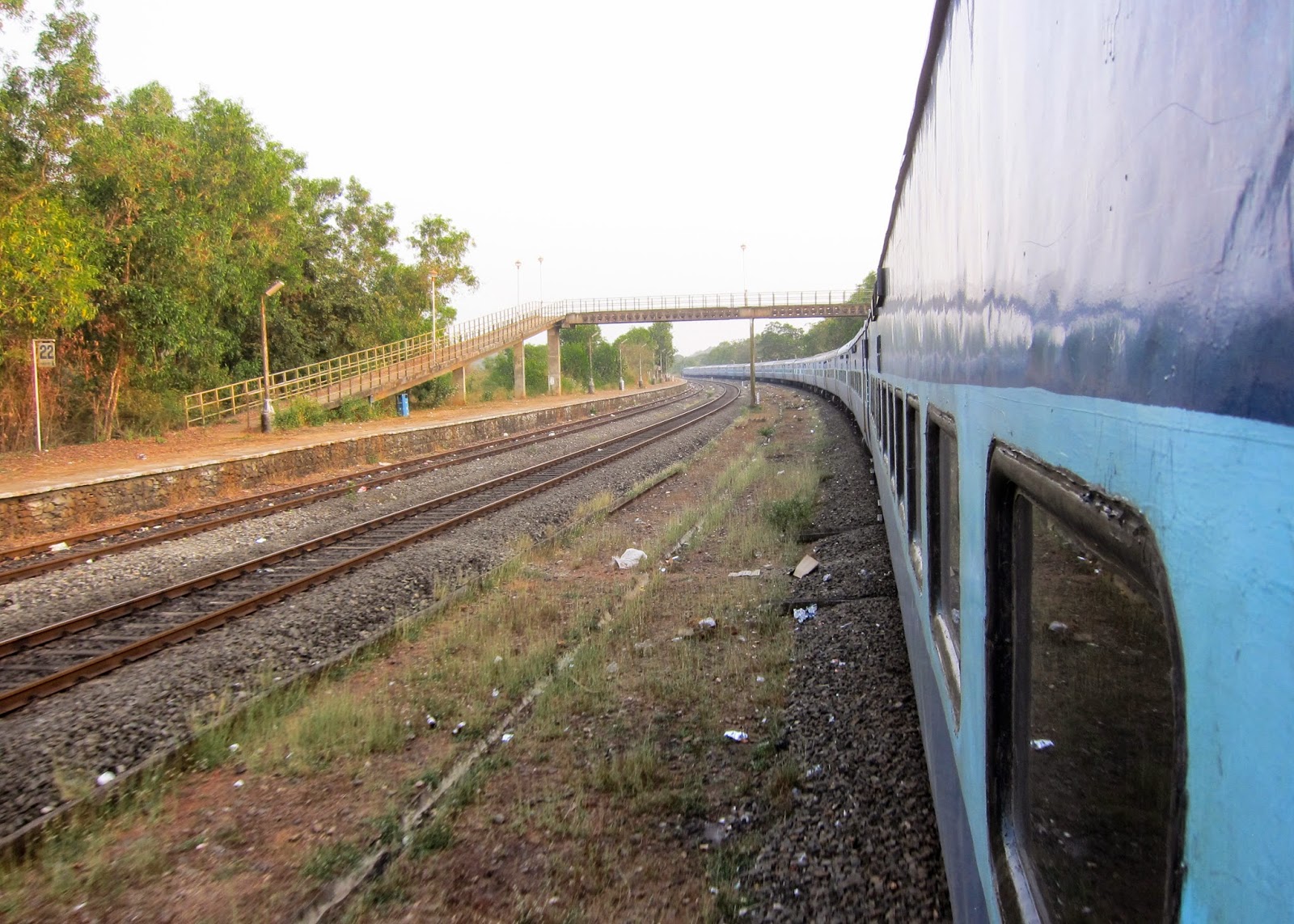
Such gloomy thoughts, and it’s still dark outside when the old iron beast shudders itself from its slumber and reluctantly rolls out of Victoria Terminus like a long, lazy snake. As night turned to day, my breakfast arrived (although I’d already devoured an erratically acquired bag of crisps and some inappropriately named “Happy Happy” biscuits). And as I tucked into delicious spicy potato fritters wrapped in slices of buttered white bread, I was treated to my first ever sight, there in the hazy light of dawn, of a grown man defecating in public.

There are 115,000kms of railway tracks in India, and shitting between them, or simply throwing your rubbish onto them, is apparently considered a public duty. 115,000kms of railroad - that’s nearly three times round the equator - linking up this vast country and transporting over 8 billion passengers a year, and every last inch of it is heaped in shit. Maybe everyone figures that since the toilets flush straight on to the tracks anyway, they might as well join in. If only they treated this sort of behaviour with the same severity reserved for travelling sans ticket which could net you either a £10 fine or six months in prison.


Breakfast precipitates an immediate need to sleep. I lay there, train rocking from side to side, the chassis of the carriage rumbling over the tracks just a few feet beneath me, a nineteenth century air con unit vibrating itself to bits in between, and faltered in and out of slumber. In one of those moments that straddle the boundaries of consciousness, I became aware that I was just a body.

One body, on a train filled with bodies. One train, in a country filled with trains. One country, on a planet filled with countries. And somehow the fact that I am foreign, and a long way from home, seems completely irrelevant when you look at it like that. I imagined my carriage as a bird might view it, far up in the sky, looking down on the train, but getting further and further away as we rolled on, perspective widening and the thin finger of metal seeming less and less significant the further away it got. And inside, I was still just a body, huddled in some corner. Baggage.


This didn’t depress me remotely, but when I woke, I was in a lighter mood. Day was in full flow and the sun was shining bright. I stretched my legs at a few stations, and hung out of the open door to let the hot wind bake my skin as the most beautiful countryside tumbled by.


I read, and wrote, and ate and slept. If there had been bars instead of a door I’d have played chess with the guy in the carriage next to me. (Actually, having spoken to him later, maybe not). And then I thought of the Simone Weil quote about the two prisoners in adjacent cells who learn to communicate with one another by tapping on the wall; “The wall is the thing that separates them, but it is also their means of communication,” she writes, “Every separation is a link.” 


And then I stopped thinking because I think I’d been in there too long, and anyway day had turned back into night by now, and it was gone half past seven when we arrived in Madgaon. I felt sort of intoxicated by the journey, so I made my way to the beach, drank a couple of very cold, very large beers, before collapsing in my hut where the sound of the Arabian Sea crashing into the sand sent me quickly off to sleep....


Friday, 30 January 2015

Bombay Mix

I was about to begin describing Mumbai as a place of complete extremes and stark contrasts, but then what city isn’t? Bleurgh.

Mumbai lies on Salsette island, the most populous in the world, and at its southernmost point the city reaches out into the Arabian Sea like a claw. The money has made it's way down here over the years, so the closest you get to real poverty is what you glimpse through the taxi window on the way from the airport to your budget hotel.

The Taj Palce Hotel, Mumbai
The first impression on that journey is one of a developing country. The houses, when they are houses and not slums, are stained and crumbling and crammed together. The sidewalks are alive with noise and activity; people of all ages buying, selling and carrying things, negotiating their way through stray dogs, men and other animals. It is noisy, dusty, dirty and smelly (but not as smelly as one might fear). I gazed out of my squat little taxi, in that strange post-flight trance, and felt ever so slightly enthralled. 

The second impression, is that they drive like maniacs. There are no rules. I instinctively like places where they ignore the lines on the road. Why drive three cars abreast when you can fit four? Why not have people undertaking, pulling out in front of each other, ignoring red lights and persistently reminding each other where they are by sounding the horn?

The world's most ignored road sign
At 6:30 this morning I took a cab to the train station, and the driver, a man of indeterminate old age (or youth, impossible to say), was honking the horn the entire way, despite ours being the only car on the road. He drove his battered old Hyundai as fast as he could, probably faster than he’s ever been able to, and we were tossed around from pothole to pothole as though we were driving across the surface of the moon. Driving like a maniac is in this guy’s DNA.

If you’re not careful though you might never get beyond the soundtrack of the traffic, and you need to. Once you’ve tuned out and the cacophony is reduced to an irritating background squeal, you really start to notice that the city itself is actually quite peaceful, and most of the people in it rather sedate and serene. There is a natural pace and rhythm to life here: a soft, slow, lilting calm.

Horniman Circle, Mumbai
I stepped out of the madness of a main road into a small fenced park on a roundabout and sat in the shade to read my map, waiting for someone to come over and start hassling me. Hawking something I neither want nor need, or encouraging me to take a tour, taxi or daub red dust on my forehead and throw a garland round my neck. But they didn’t. Not here, not anywhere. (Actually someone did do that to me – in the lobby of the Taj, but that’s what you get for staying in the Taj).

In the side roads where there are no cars, the tranquility resumes. In Oval Maidan, there must be ten separate cricket matches going on, watched by countless people from the shade of the palm trees. Groups of men loiter outside buildings or huddle around street stalls, eating, talking and smoking. But mostly eating. At times it feels like the whole place is on a permanent lunch break, or that the city just held a simultaneous fire drill and everyone's standing around waiting to be allowed back in to work.

Cricket at Oval Maidan, Mumbai
When I went for a run yesterday morning, the streets were still empty, but the Maidan cricket pitches were full and the long curving promenade of Marine Drive thronged with people of all shapes, sizes and dress senses; stretching, doing yoga, balancing, walking, chatting, jogging. There was a wonderful sense of joy and contentment - that this was a part of the day they were having for themselves.

The cab I got last night pulled over after 100 yards and the guy asked me to wait a minute while he went for a piss. Maybe he wanted the extra 5 rupees this bagged him, or maybe everyone's not actually in such a hurry, and when you’ve got to go, you’ve just got to go.

Thursday, 29 January 2015

The Gateway of India

Home. Taxi. Airport. Aeroplane. Airport. Taxi. Hotel. And that's it - you're in India. Except there's a problem, because somewhere in amongst all that, I have lost the will to live, let alone the will to walk out the hotel room door.

I've been here before, and it's not an easy place to drag yourself out of - a sort of micro depression that completely cripples you. Your room, in a very foreign country, after an oppressive, sleepless flight. It cradles, it protects and it imprisons. The longer you stay in it, the harder it gets to leave. The softness. Then within it, you retreat to the bed. Softer still. Warm. A clock ticks away somewhere. The hour hand slices through the numbers, and with each one that falls to the floor, another opportunity to free yourself is missed. Excuses, excuses.

The irony of all this is that the only part of India I can actually see, if I'm bold enough to peek out from between the curtains, is this:


It's called The Gateway of India. If only I could muster the strength and energy to walk through it, I wouldn't have to lie curled up under these sheets trying to figure out whether I'm here because I'm running away from everything, or here because I'm running towards it.

This morning I woke early and watched the sun rise over the giant arch, looking a lot smaller and a lot more orange than I was expecting it to. I laced up my trainers and got the fuck out of there before it got any bigger. 

After three miles or so, somewhere along Marine Drive, I emerged from the shadow of the city to find myself bathed in the sanguine glow of that little orange disc, and I swear I have never, ever, felt more alive.


Wednesday, 28 January 2015

The Last Place in the World

I'm going to level with you - I have believed, strongly, and for as long as I can remember, that India is the last place in the world I would want to visit. 

And in case you're wondering why, here is what I posted on Facebook as I sat at Heathrow on Monday night:
I feel what's really missing from my life is prolonged exposure to relentless pestering from every living being within a five mile radius, an assortment of vile and inescapable digestive problems and the persistent stench of human waste. So I'm off to India for a couple of months.
I was joking of course, but it's not far from the truth. I don't want to watch grown men shitting in the street, or stray animals feeding on their waste. I don't want to be commodified by every person I encounter or targeted by those looking to exploit my foreignness, gullibility or good nature. Or sadder still, lose my good nature because I come to expect the worst from people. And I don't want my intestines laid to waste by a plethora of undetectable bacteria; to have perhaps the greatest pleasure of all, eating, hijacked from the inside and turned upon itself.

But I'm here anyway, and I'm here because I want to be. Because the last place in the world you want to go to should be the very next place you do. Because life is never more rewarding than when you challenge your preconceptions, reach beyond the limits of what you find comfortable and comforting, and throw yourself headlong towards the things you fear the most.

Most of the time, those things are in our heads. In India, I think a few of them might be on the streets as well....


Thursday, 10 February 2011

Round the World

For most of the last year, I have felt as though I have been writing a story. That my travels formed some kind of narrative and that today I would pen its final words.

Keeping this blog has made me so much more aware of my daily experiences. It's forced me to crystallise and articulate the thoughts and ideas that have occurred to me along the way. And all along, I've been wondering how the story would end - writing bits of it in my head, clutching at the themes and ideas that I've towed around with me and wondering how I could tie their loose ends together. I've amassed quotes from the things I've been reading, held onto them until the end.


The shape of the story was pretty obvious really - a round the world trip is only ever going to be circular. Back from whence I came, richer for all the experiences and back into the arms of the friends and family I left behind.

Round the world! There is much in that sound to inspire proud feelings; but whereto does all that circumnavigation conduct? Only through numberless perils to the very point whence we started, where those that we left behind secure, were all the time before us.
Moby Dick

It's a curious thought. That actually leaving and travelling is an act of regression - you just put yourself a year behind and then try and catch up. Which makes the culmination of the experience its object. Everything that happens serves only really to advance you to the end (which was also the beginning):


We shall not cease from exploration. And the end of all our exploring will be to arrive where we started and know the place for the first time.
T. S. Eliot

And then, back home, as the days and weeks advance, the journey, the adventure, would slip quietly beneath the waves of time; the memories and experiences would fade, the only question being which of them would stand the longest.

But no. Having assumed that I would have spent all of the last week feeling as though I were sliding into an abyss, I have actually felt pretty happy and excited about it all. And most of that joy comes from the realisation that this is not the end. Not any kind of end. Just another cusp, another line between two things. And I can quote myself on that one:

An understandable duality shrouds you when you stand on the brink of something. A border or cusp, real or figurative; leaving one thing behind, entering another. Reflection, anticipation. It might actually be the greatest thing about travelling, moving form one place to another, body and mind constantly charged and energised by these changes. And not just travelling but life, too, come to think of it.

It's not just this. A clock has been running alongside me for the whole trip. I knew roughly when I would make the big changes and swap continents. I rarely wanted to leave anyone or anywhere, but each time I had to, or chose to, I kind of knew that it was time. And that's exactly what it feels like now. Time.

And so I'm sat in the lounge at Sydney airport preparing (not that you ever can) for the monster 24 hour flight that awaits me, and soon I will be home. But I won't be leaving this year behind in my wake, forever glancing over my shoulder as it is slowly consumed by time. Quite the opposite in fact - the things I have seen and done, the places I have walked, the people I have met and loved, their faces, the landscapes; the dirt and sand I've trodden through, oceans I've swam in, mountains I've climbed; every single breath I've taken has filled my lungs with something new and special and lifted me way higher than I ever thought it possible to go, and I will carry them with me for the rest of my days.

Once you have tasted flight, you will forever walk the earth with your eyes turned skyward, for there you have been, and there you will always long to return.
Leonardo Da Vinci

The world we inhabit is a place that is incredible way beyond our comprehension. I implore you to get out there and explore it. I know it's not going anywhere, but we are. We are dying, from the minute we arrive on the planet, we are sliding towards our inevitable end. Get out there now. Feel the earth between your toes. Scratch beneath the surface of all the things that surround us and they'll reward you every single day of your life.

If you're lucky, like me, you could get close enough to the Heart of this world that you might just feel it beat.